"You can't run your own exchange — that's what platforms are for." It's the assumption that keeps people renting someone else's rails, handing over custody of their users' money, files and data in exchange for convenience. It's also increasingly wrong. If you want a private, self-hosted place where people trade digital assets — tokens, files, whole datasets — and where an LLM agent can safely manage the accounts on their behalf, you can stand one up on infrastructure you control. Here is how the pieces fit on VBWD, and why the boring plumbing is the part you no longer have to build.
What we're actually building
The goal is a members-only exchange with three kinds of tradable asset and an AI operator layer on top:
- Tokens / credits — an internal unit of account users can hold, send, earn and spend.
- Files — encrypted documents and media that can be sold, licensed or handed to another user.
- Datasets — packaged data that buyers get metered or entitled access to, not just a download.
And the twist: LLM agents that can manage users — top up a balance, grant access to a dataset, move a file, settle a trade — acting through a safe, permissioned interface rather than by scraping a UI. Every one of these is a real, switch-on capability on the self-hosted, source-available VBWD platform.
The one idea that makes it coherent
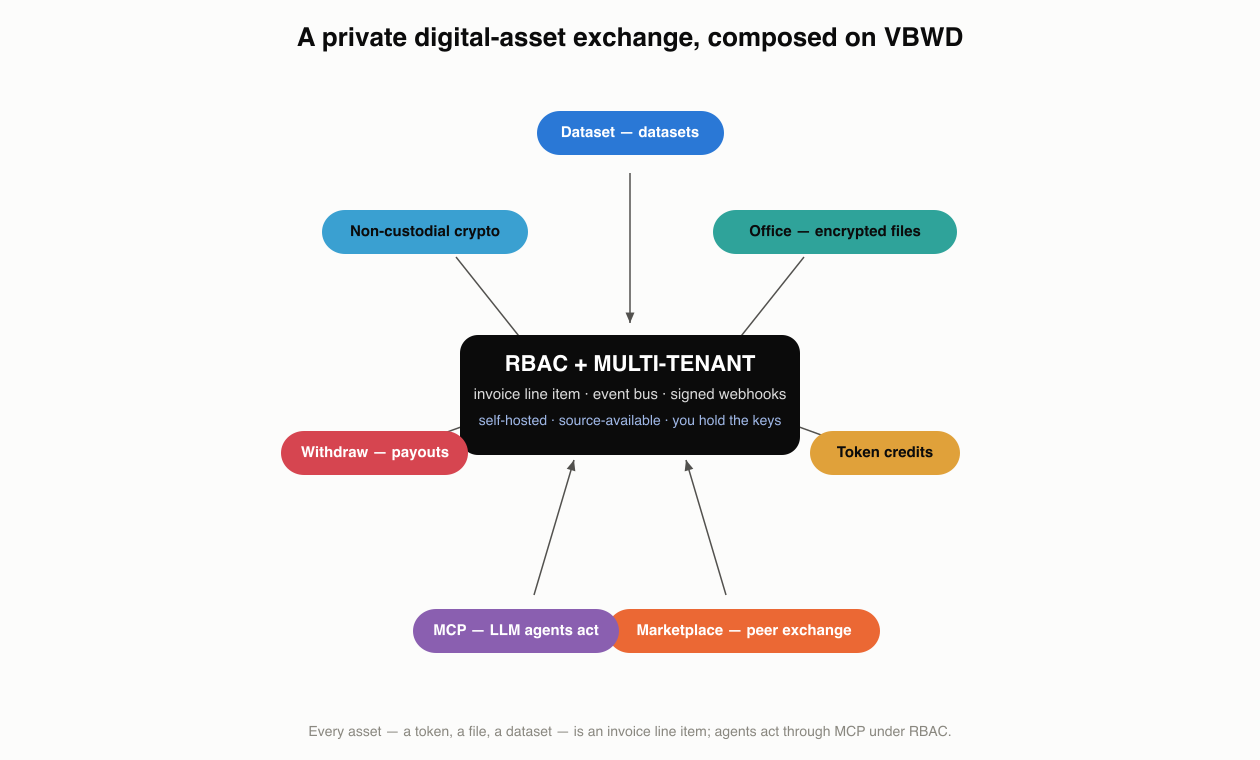
Before the plugins, the principle. In VBWD everything sellable — a token top-up, a file licence, a dataset subscription, a peer-to-peer trade — is declared as an invoice line item against one shared interface. That means a token, a file and a dataset are not three separate money systems bolted together; they are three kinds of line item on the same ledger, priced, taxed, discounted and settled the same way. An event-based contract engine keeps the balance between what a user owns (assets) and what they owe (obligations). This is what lets an agent operate across all three asset types without you writing a reconciliation layer per type.
Setting it up, plugin by plugin
You enable capabilities rather than fork the core; plugins toggle on and off without a restart.
- token_payment — turn on the token/credit economy. This is your internal currency: balances, transfers, metered spend. Users earn or buy credits and spend them across the exchange.
- office — the self-hosted, encrypted document suite holds the files at rest. Selling or transferring a file becomes a line item that moves entitlement, while the bytes stay inside your perimeter, encrypted.
- dataset — publish datasets as priceable products where a purchase grants an entitlement and API access, not just a file dump. Ideal for data that should be queried under a licence rather than copied.
- marketplace — the multi-vendor layer that makes it an exchange rather than a shop: any member can list, any member can buy, each with reputation and their own storefront.
- withdraw — payouts, so a seller can take real value out. Because it's the same ledger, a payout is just another line item drawing down a balance.
- crypto — provider-agnostic, non-custodial settlement: crypto and stablecoins settle straight to the user's own wallet. The platform never takes custody, which for an asset exchange is the difference between "software" and "regulated money-transmitter headache."
- RBAC + multi-tenant — the core. Roles decide who can list, trade, withdraw or administer; multi-tenancy lets you run isolated exchanges (per community, per client) from one deployment.
Letting LLM agents manage the users
This is where it stops being a normal marketplace. VBWD's mcp plugin is an MCP-native, agent-callable capability server: it turns platform actions into tools an LLM agent can discover and invoke through a clean, safe surface, instead of driving a browser. An agent — yours, or one a user brings — can check a balance, grant a dataset entitlement, move a file, or execute a trade, and every action it takes lands as an invoice line item on the same ledger, logged by the event-driven core. Two properties make this safe rather than terrifying:
- The agent inherits RBAC. It can do exactly what its role allows and nothing more — a "concierge" agent that tops up balances and grants access cannot suddenly authorise withdrawals if its role forbids it.
- Every action is an auditable event. Because the agent acts through MCP against the contract engine, there is one ledger and one event log to review — no separate "agent actions" database drifting away from the real one. Signed webhooks let you trigger downstream automation (notify, provision, fulfil) with cryptographic proof the event genuinely came from your platform.
You can also give members a natural-language front door with the chat and LLM modules, so a user simply asks their agent to "sell my dataset to this buyer and move the credits to my wallet," and the agent carries it out within its permissions.
Why "private and self-hosted" is the whole point
For an exchange of tokens, files and data, self-hosting is not a preference — it is the trust model. Your users' balances, encrypted files and datasets live inside a perimeter you or your institution control, the code is open to audit, and non-custodial settlement means you are not holding other people's money. When the asset being traded is sensitive, "it runs on infrastructure we control and you can read the source" is the only answer a careful counterparty should accept.
The honest boundary
VBWD gives you the exchange plumbing — the ledger, the assets, the payouts, the agent interface, the permissions. It does not give you a business or a legal opinion. You still design the trust-and-safety model, decide what may be traded, handle dispute resolution, and — critically — get advice on the regulatory treatment of tokens, payouts and any securities-like assets in your jurisdiction, which varies enormously and is not something a framework can answer for you. What you no longer have to build is the hard, generic 80%: accounts, a multi-asset ledger, encrypted storage, metered access, payouts and a safe way to let agents act. That is exactly the part that usually kills these projects before they reach the interesting question.
If a private exchange where people trade tokens, files and datasets — and where an AI agent does the admin — is the kind of thing you want to run on infrastructure you own, the platform is open. Browse the documentation, clone the public SDK at github.com/VBWD-platform/vbwd-sdk-public, or get in touch to talk it through.
VBWD is source-available under BSL 1.1 — free for commercial use while annual VBWD-attributable sales stay under the value of 6.7 BTC per year.