"You can't build a Shopify for one region without rebuilding payments for every store." That belief is what keeps the market open. The whole cost and complexity of a hosted-storefront business concentrates in one place — wiring each merchant to the payment rail their customers actually use — and on VBWD that is the part you do not build per store. One deployment can host thousands of creator storefronts, each localized to its own market's rails: Pix and crypto across LATAM, PromptPay and TrueMoney across Southeast Asia, YooKassa where it belongs, cards elsewhere. Creators pay a subscription, referrals compound the roster, and the provider-agnostic payment core means a new local rail is a configuration, not a project.
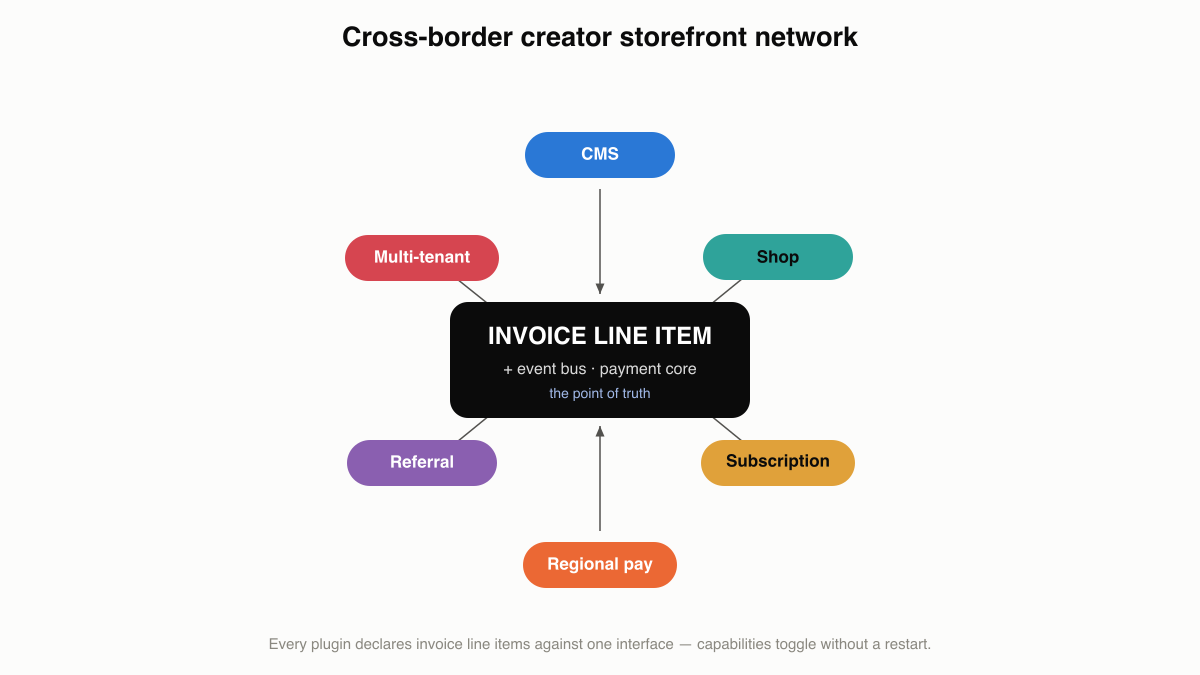
The reason a regional Shopify is hard is never the storefront. It is that every market pays differently, and a platform that only speaks card checkout is invisible to a buyer in São Paulo or Bangkok. VBWD inverts the difficulty: the payment core is provider-agnostic by design, so "which rail does this tenant use" is a setting on the tenant, not a fork of the codebase.
One deployment, thousands of storefronts
The foundation is the multi-tenant core. A single VBWD deployment isolates each creator as a tenant with its own storefront, catalogue, orders, and branding, while you operate one platform underneath them all. The cms plugin gives every creator their content, pages, and blog — the landing page and marketing surface that makes a storefront feel like a brand rather than a table of SKUs — and the shop plugin gives them the actual commerce: products, variants, orders, stock, and shipping. A creator gets a real store; you get one deployment to run, patch, and scale. That ratio — thousands of merchants to one operational footprint — is the entire economic argument for a hosted-storefront platform, and multi-tenancy is what makes it hold.
Because plugins toggle on and off without a restart, you can offer tiers of capability without maintaining separate builds. A basic creator gets cms and shop; a premium one also gets, say, subscription products or discounts — same deployment, different toggles per tenant.
The point everyone underestimates: local payment rails
Here is the non-trivial angle, and it is worth dwelling on because it is where competitors quietly fail. A buyer in Brazil reaches for Pix. A buyer in Thailand reaches for PromptPay or TrueMoney. A buyer in Russia reaches for YooKassa. A buyer holding stablecoin wants to pay in crypto. If your platform only offers a card form, a large share of each of those buyers simply does not convert — not because they don't want the product, but because you didn't speak their money.
VBWD ships a provider-agnostic payment core with a wide set of providers already available — Stripe, PayPal, Conekta, Mercado Pago, PromptPay, Toss, TrueMoney, YooKassa — plus non-custodial crypto/stablecoin settlement where funds land directly in the merchant's own wallet. Each tenant is wired to the rails its market uses, and the storefront presents the right options to the right buyer. Crucially, adding a gateway that isn't yet in the set is roughly 100× less code than on a classic platform, because every provider plugs into the same interface behind the same invoice line item. So "expand to a new country" becomes "add its rail once, switch it on for the tenants there," rather than a re-platforming exercise.
That single fact — payments as configuration, not construction — is what makes a region-specific Shopify economically sane. You are not rebuilding checkout a thousand times. You are building it once and pointing tenants at the providers their customers already trust.
Subscription bills the creators; referral grows them
A hosted-storefront platform makes its money from the creators, and the subscription plugin is exactly that engine: tarif plans, add-ons, checkout, and recurring billing. Creators pick a plan, add capabilities as add-ons, and are billed on a recurring cycle — all as invoice line items against the same shared interface every other part of the platform uses, so your own revenue reconciles as cleanly as your tenants' sales do. You can settle those creator subscriptions through the same provider-agnostic core, which matters when your creators are themselves spread across regions.
Growth is the other half. The referral plugin lets creators bring creators — the classic compounding loop of a platform business, where every satisfied merchant is a channel. Referrals expressed through the platform are tracked and rewarded as real transactions rather than a spreadsheet, so the incentive is auditable and the growth is measurable.
The honest boundary
Now the caveat, and it is a serious one for this particular business. VBWD gives you the multi-tenant storefronts and the rails to charge in every market. It does not make you a payment aggregator or absolve you of the rules that come with moving money across borders. Onboarding a merchant to a regional processor, satisfying that processor's KYC, handling settlement and payout obligations, and meeting each country's tax and financial-services requirements are your responsibility. Non-custodial crypto keeps you out of the custody business by settling straight to merchant wallets, but the regulatory picture still varies by jurisdiction. VBWD makes the technical integration cheap; it does not make you compliant. Budget for legal and financial-operations work in every market you enter.
You also still run the platform: creator support, trust and safety, content moderation on the storefronts, uptime, and the operations of self-hosting. VBWD is a substrate — it removes the payments-and-tenancy engineering that would otherwise consume your first two years, not the work of running a marketplace of merchants.
Why this is real, not aspirational
The credibility of this constellation rests on the pieces already being shipping capabilities. Multi-tenancy and the agnostic core are foundational. cms and shop already power content-driven stores. subscription and referral already bill and grow. The payment providers listed above are already available, and non-custodial crypto settlement is already part of the core. The platform has carried verticals as different as a pharmacy shop, dataset publishing, a tarot app, and a dice-market game, which is the evidence that the seams hold when a real product leans on them. A localized, creator-hosting storefront platform is not a new codebase; it is multi-tenant VBWD with the right rails switched on per market.
Start from the public SDK at github.com/VBWD-platform/vbwd-sdk-public, read the payments and multi-tenant guides at vbwd.cc/docs, and if you're planning a region-first storefront platform, talk it through with us at vbwd.cc/contact.
VBWD is source-available under BSL 1.1 — free for commercial use while annual VBWD-attributable sales stay under the value of 6.7 BTC per year.