Every week brings another headline announcing the end of the software engineer. AI writes the code now. The junior developer is obsolete. Learn a trade. It is a tidy story, and it has one problem: the hiring data says the opposite is happening.
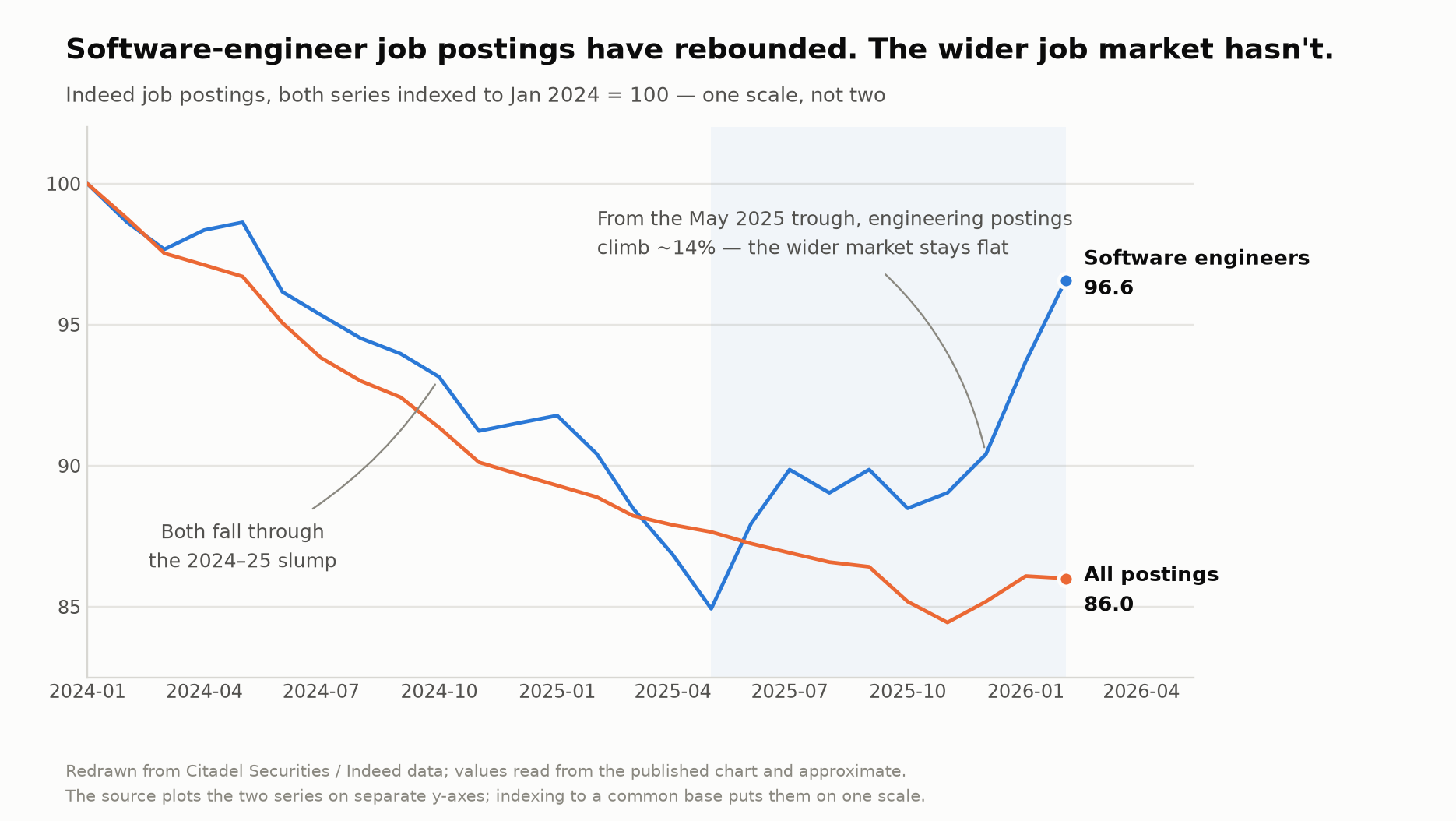
Job postings for software engineers have been climbing for roughly the past twelve months. Not holding steady — climbing, and climbing faster than the job market as a whole. From the trough in May 2025, engineering postings are up around 14% while overall postings have gone essentially nowhere. The line that was supposed to fall off a cliff turned around and went up.
Read the chart carefully
A note on how we've drawn this, because it matters. The original chart plots the two series on two different vertical axes — engineers on the left, all postings on the right. Dual-axis charts are the easiest way in the world to manufacture a story: slide one scale against the other and you can make any two lines cross wherever you like. Both series here are index numbers, so we've re-indexed them to a common base (January 2024 = 100) and put them on a single scale. The divergence survives. It's real, and it's recent.
What the chart actually shows is two phases. Through 2024 and into early 2025, both lines fall together — that was the broad post-boom hiring correction, and engineering had no special immunity. Then, around May 2025, they separate. Engineering postings turn up sharply. The wider market doesn't. Whatever is happening to developer demand is specific to developers, and it is pointing the wrong way for the "AI took the jobs" thesis.
We expected the opposite
Let's be honest about the prediction. The arrival of capable LLMs and agentic coding tools — Claude Code, Cursor, and the rest — was supposed to reduce demand for engineers. The reasoning seemed airtight: if a machine writes the code, you need fewer people to write code. Many of us said so.
That reasoning contains a hidden assumption, and the assumption is wrong. It assumes the amount of software the world wants is fixed — a pie of fixed size, to be divided between humans and machines. Make the machines better, and the human slice shrinks.
But the demand for software was never fixed. It was rationed by cost.
What actually happened: the price of software fell
Here is the mechanism. Every company has a long list of software it would like to have and isn't building. The internal tool that would save the ops team ten hours a week. The customer portal. The integration between two systems that currently talk via a spreadsheet and a person. These ideas aren't unknown — they're on a list somewhere, below the line, because the engineering cost exceeds the expected value.
Now cut the cost of building software substantially. Nothing about the ideas changed. But the line moved. Projects that made no economic sense at the old price make perfect sense at the new one, and they get greenlit — at startups, and increasingly at traditional enterprises that never thought of themselves as software companies at all.
And greenlit projects need engineers. Someone has to specify the thing, review what the model produced, integrate it with the systems that already exist, secure it, deploy it, keep it running at 3am, and evolve it for the next five years. AI compressed the writing step — which was never the whole job, or even most of it. What it did was make it economical to start far more projects, and every one of those projects lands on an engineer's desk.
This is why the two lines separate. Cheaper software didn't mean less software. It meant more.
This has happened before — and we already know how it ends
None of this is unprecedented. It is close to a rerun.
In the 1980s, the spreadsheet was going to destroy accounting. The fear was reasonable and the arithmetic obvious: a machine that recalculates a financial model instantly does the work of a room full of people with paper ledgers and adding machines. Clerks would be swept away.
What actually happened is that financial modelling became so cheap and so fast that companies started doing vastly more of it. Analysis that was previously unthinkable — scenario planning, sensitivity analysis, re-forecasting every month instead of every year — became routine, because the cost of asking a question collapsed. Demand for people who work with numbers didn't fall. It exploded. The spreadsheet didn't replace the analyst; it created the modern financial analyst.
The same pattern shows up whenever a tool makes a valuable activity dramatically cheaper. Consumption rises faster than the efficiency gain, and total demand for the humans who wield the tool goes up, not down. Cheaper looms, more cloth, more textile workers. Cheaper compute, more software, more programmers. The people who lost were rarely the practitioners — they were the ones who refused to pick up the new tool.
What this doesn't mean
A rising line is not a promise, and it would be dishonest to oversell it. A few caveats worth holding.
The recovery starts from a deep trough. Engineering postings are up sharply off May 2025, but they are still below where they stood in January 2024 — this is a rebound, not a boom, and anyone who lived through the 2023–25 market knows the difference.
The composition of the work is changing even as the volume grows. If a substantial share of code arrives machine-written, the scarce skill shifts toward judgment: architecture, review, knowing what to build and what a model quietly got wrong. That's a real change in what the job is, and it is plausibly harder on the classic entry-level "write the CRUD screen" role even while total demand rises. The trend line doesn't rescue every individual on it.
And twelve months is twelve months. One turn in one dataset is a signal, not a law. It's a good deal more evidence than the headlines have, but it isn't destiny.
The read
The "AI is replacing developers" story got the mechanism backwards. AI didn't shrink the amount of software the world wants; it lowered the price, and demand at the new price is much larger than demand at the old one. More companies now see software as accessible rather than as a forbidding cost centre. More ideas clear the bar. More projects start — and every project still needs someone who can build, scale, secure, and maintain it.
The spreadsheet didn't end accounting; it made analysts indispensable. The current evidence suggests agentic coding tools are doing the same thing to software engineering. The chart is not showing us the profession's decline. It's showing us the first months of its expansion.
VBWD is source-available — clone the public SDK on GitHub and start building.